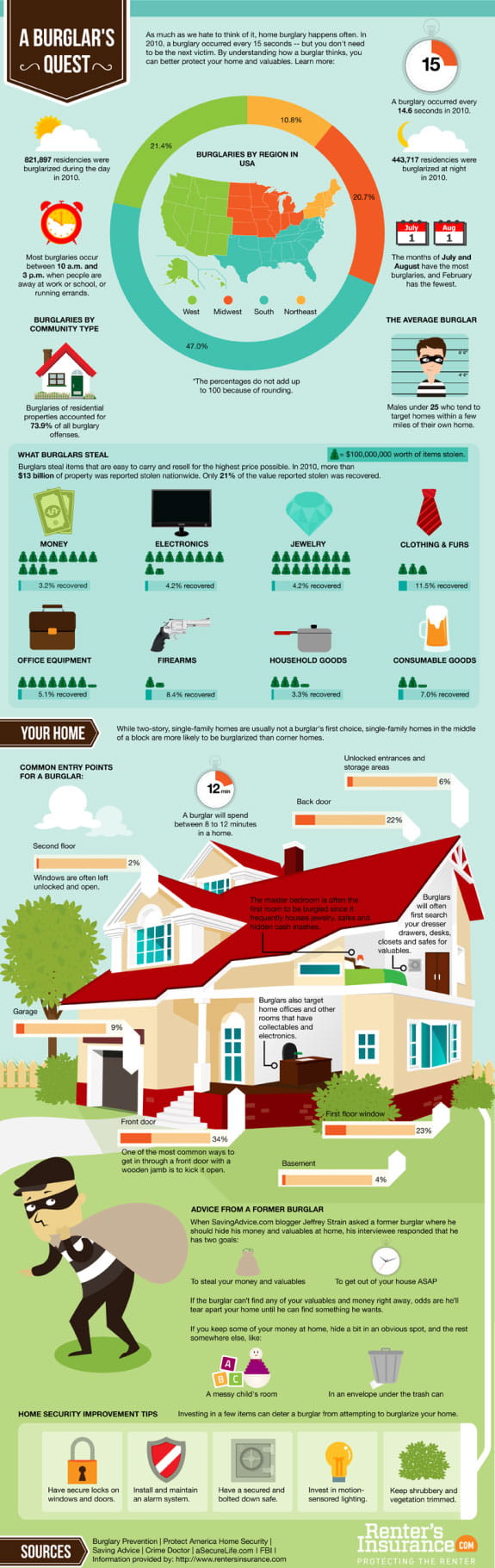
Burglary is defined as the breaking in to and illegal entry of a structure with the intent to commit a crime, and while the statistics state that property crime is going down that is no reason to let down your guard. Remaining vigilant and taking an active role in protecting your home from burglars is the best way to ensure that you do not become a burglary statistic. There are many things that you can do to keep from becoming one of the 2,329,950 homes in the United States that are burgled annually. Not all steps to prevent burglary include the installation of a high tech security system either, many of the things that you can do to keep your home protected are small and affordable changes.
When the subject of home protection is raised, the first thought that everyone jumps to is the installation of an expensive home security system; however, there are many other preventative measures at hand. Certainly a home security system is one of the best ways to deter burglary, as statistics show that a home without an alarm system is 2.7 times more likely to be burglarized; however, installation is costly and not every family can afford such a big step. There are many other options that can deter burglary though, including: using automatic light timers, utilization of garages, placing radios and televisions on automatic timers, lowering the volume on telephones in the home, hold mail and newspaper delivery, arrange for home maintenance, placing drapes or blinds on timers, avoid leaving telling garbage out until the last minute, inform a trusted neighbor when you are leaving town, increase lighting around your home, display alarm decals, avoid hiding keys outside your home, keep valuables away from windows, lock all doors and windows whether you are home or not, install good locks on patio doors and garages, purchase insurance and inventory your belongings, and be a vigilant member of the community.
Without further ado, here's a list of the top 17 ways to protect your home from burglars:
Automatic light timers can be purchased from hardware stores, megastores (like Target and Wal-Mart) and occasionally from your local grocery store. These timers vary in price depending upon the complexity of the item you choose but for the purposes of keeping your home looking lived in even a basic timer will do. Timers should be placed in commonly used rooms of the home, such as the living room and the bedroom and laps should be plugged in to them so that they can be set to turn on at a “normal” time. As the lights come on according to a normal schedule in your home burglars will not be able to determine that you are not home based on a lack of activity in the home.
Not all burglary deterrence is focused on the times when you are not home, for example by parking your cars outside your home you can tip off burglars as to your daily schedule. Instead of allowing your cars to tip off outsiders as to your schedule you should always make use of your garages to conceal your cars so that no outsiders are able to determine a pattern in your daily activity. Many times burglars will watch homes that park their cars on the street or in the driveway of the home because when these cars are missing they assume that no one is home to catch them in the act.
Lights aren’t the only thing in your home that should be set on automatic timers. Thieves are becoming much more knowledgeable in regards to the tricks that homeowners use to deter them, things such as placing lights on timers; however, one thing that seems to be particularly effective is placing televisions and radios on timers as well. By turning up the volume on these electronics so that they can be head from outside of the home (don’t make them too loud though!) you will confuse any potential intruders with the noise coming from inside the house. While many people commonly use lighting to implicate activity in the home, they often forget to add the noise element which is often the most convincing aspect of deterring invasion. Timers for televisions and radios should be placed on a schedule similar to the usual schedule that you keep at home.
This method of deterring break-ins is becoming somewhat obsolete as more and more households eliminate the use of landline telephones; however, for those homes that still have landlines it is important to turn down ringers when you are out of town. If ringers are not turned down or muted there is a risk that your phone will ring repeatedly without answer, tipping off potential burglars to your absence.
One of the most well known tips in deterring burglars is to hold mail and newspaper delivery when you are leaving town. If you are only leaving town for a few days you may find that it is easier to have a neighbor pick up your mail and newspaper, but it is important that this is done in a timely manner to avoid tipping off potential intruders. Leaving newspapers in the driveway is one of the first signs that your home is unoccupied and if you have a regular mailbox leaving mail inside is an easy way for burglars to determine whether or not you are home. Some homes utilize lock box mail systems which avoid the necessity for stopping mail when leaving town for just a few days; however, homes that don’t use this system should stop mail for even the shortest absence as their mailbox can be opened easily by passersby.
Arranging for home maintenance is not an issue when leaving home for just a few days; however, if you plan on taking a long vacation or even if you are going to be in the hospital recovering from surgery for a little while it is important to arrange for home maintenance. Being away from your home for an extended period means that there is no one home to cut the grass and do the normal chores that get done when a home is occupied. Hiring someone that you trust to come by and cut the grass and do any other home maintenance that you routinely do is a great way to indicate that your home is occupied.
Much as your patterns of light use can tip off potential thieves as to when you are and are not home, your use of blinds and drapes does the same thing. Fortunately there are a few options on the market that can be fitted to blinds and drapes to open and close them on a timer. While these systems are more expensive than light timers due to the complexity of the technology in them, they are worth purchasing particularly if you are intending to be out of town for an extended period of time. If you cannot afford a timer system like this, another solution is to pay a trusted neighbor to come to your house each afternoon to pull your blinds or drapes. Having a neighbor perform this task provides the benefit of human action, meaning that if your timer malfunctions your blinds and drapes will still be pulled; however it also brings the worry that perhaps your chosen neighbor is not as trustworthy as you initially thought.
Garbage is one telltale sign that tips off burglars to a variety of situations and as such it should be monitored whether you are or are not at home. When you are home your garbage can be used by potential burglars to determine what items you have in your home that are worth stealing, this is particularly important to keep in mind over the Christmas holidays and when making large purchases. It is important to hold on to boxes from valuables and big purchases until the last minute on trash day rather than leaving them out over night for thieves to take note of and plan a burglary.
Garbage is also telling when you are not home; leaving out no trash cans on garbage day or having a neighbor pull out your empty trashcans can also tip off burglars to the fact that there is no one home. The best way to avoid this situation is to ask a neighbor to use your trashcans and leave them out for you on trash day so that when they are left out, they will at least be filled with garbage.
It is always helpful to have a neighbor that you trust in the neighborhood, someone that you can leave a spare key with and have keep an eye on your home when you are not there. While a neighbor watching your home may not be able to prevent a burglary from occurring while you are not home, it is a good way to have someone actively watching your home so that you can find out if something is amiss. A trusted neighbor can also inform the police and you if something unusual has occurred at your home while you are out of town. In the case of burglaries that involve theft items are rarely recovered but when they are it is because of fast action that tipped off the police and local pawn shops to be looking out for certain items that were stolen from your home. Having someone watch over your home is also a good way to handle other emergency situations such as fires, broken pipes that cause flooding, or other damage occurring as a result of natural disasters.
Increasing lighting around your home is always a good idea whether you are leaving town or staying at home. Dimly lit properties are far easier targets for thieves because there are more places to hide and more areas of the home that provide covert access. Keeping your house well lit with spotlights or, preferably, motion detection lights, is a good way to deter burglars from targeting your home. Reducing the ability for burglars to break in to your home without being spotted is one of the best, yet affordable methods to lower your chances of being burglarized.
Whether or not you have a security system installed in your home, often times all it takes is the presence of an alarm system sticker or decal in the window to deter break-ins. Having a fake decal rarely works for this purpose; however, displaying a real decal from a legitimate alarm company works well in preventing burglaries since inexperienced burglars cannot tell if you actually have an alarm system installed or not. Note that this is not always the case and experienced burglars will be able to determine whether or not you actually have a system installed.
Many households keep spare keys hidden under planters or doormats or even fake rocks in the front garden; however, none of these methods escapes the seasoned burglar and the chances that they will get caught lower based on the fact that they had a key to gain entry. Rather than hide a key outside the home it is always a better idea to leave a copy of your house key with a trusted neighbor who can not only let you in if you lose your key, but also let themselves in to check for issues around the home when you are out of town.
While keeping valuables away from the windows may seem like a common sense suggestion, there is no telling how many homes position laptops and big screen televisions where they can be spotted from the outside of the home. Certainly big screen televisions are harder to conceal but placing any type of valuable within plain view serves to lure in a passing thief who may see your valuable and be unable to resist temptation. This concept does not just apply to electronics; however, it also applies to jewelry and antiques.
Locking doors and windows is another tip that seems like common sense, but for many people who believe that they live in a small safe town this step of home security is one that goes unheeded. Locking doors when you are not home is another line of defense against home intrusion and locking doors when you are home is not only a way to protect areas of the house that you cannot see from your location, but it is also a way to protect yourself from intruders. Some homeowners find that installing alarms on their doors and windows to signal when they are opened is another affordable method of keeping the home and its contents safe.
Two areas of the home that are favorable points of entry for burglars are garage doors and patio doors, these two locations are commonly left unlocked and unsecured. Installing a good deadbolt on garage doors helps to prevent this area of the home serving as an easily accessible break-in point. Patio doors are a little more difficult when it comes to installing locks; however, there are rods that can be placed inside the sliding door track to prevent it from being opened from outside the home. If you find yourself unable to afford a professional rod, one can easily be fashioned from a sawn-off shower rod or curtain rod so long as it fills the length between the door and the wall to prevent opening.
Purchasing insurance and taking inventory of your belongings is not actually a method to protect your home from burglary, but it is a way to recover some of your lost items monetarily should you become a burglary victim. Keeping an inventory of valuable items with pictures is also a good way to help identify missing items after a burglary and provide evidence with your insurance claim.
Not everyone is cut out to play a part on the neighborhood watch committee but being a vigilant member of the community does not mean that you have to take such a position. You can be an important member of your community by keeping open lines of communication with trustworthy neighbors and tipping off your community if you notice something suspicious. By playing a role in keeping your community safe your neighbors are more likely to return the favor and keep their eye on your home and suspicious activity that may occur when you are or are not home.
Those methods of home security listed above are not the end all and be all of protecting your home from burglars, there are many other options available including the two most recommended methods: installing a security system or investing in a dog. Installing a security system can be expensive, but so too can owning a dog. Security systems seem to be the most reliable method of home security but homes with dogs also prove less likely to be broken in to when the dog is of a breed that has either size or a reputation of aggression (this does not mean that your dog should be aggressive.) If you opt for either of these more traditional methods of keeping your home secure make sure that you are prepared for the consequences of each. Owning a security system means that you must be strict about keeping it turned on when the home is empty, you must also commit to a monitoring system if you want an alarm that ensures full protection. Monitoring systems require monthly payments and while this may seem like an added expense, you pay for what you get in terms of monitoring, a good monthly plan doesn’t have to cost a fortune but it does ensure that someone will be watching your home at all times. If you choose to purchase a dog you should first of all be a “dog person” and understand the commitment and responsibility that comes with owning a dog. A dog should never be purchased with the soul intention of keeping it as an alarm system, dogs are living creatures that value being part of a pack, so unless you are prepared to provide a secure home life and cover mandatory veterinary expenses you should consider an alarm system instead. Many people believe that an alarm system will incur more cost when monthly payments are factored in; however, a dog requires vaccinations, food, vet visits and more so in the long run there really is no case of saving money by purchasing a dog rather than a security system.
In the long run, many of the steps that you can take are a matter of common sense but in the everyday hustle and bustle of things we tend to forget. We forget to lock the door as we run out fifteen minutes late for work and we forget to lock the door when we race in after a long day at work unable to wait to change in to the comfortable sweats. Leaving reminder notes throughout your home is a great way to stay on top of the small things that help to not only keep your home safe, but also keep you and your family safe as well. If you have ever been a victim of theft or a home invasion, you know well the feeling of violation and anger that come with the territory and you are much more likely to remain vigilant in staying on top of these little things. If, however, you have never been the victim of any crime, it is easy to forget these steps but talking to someone who has experienced that situation will give you an insight in to why it is so vital to protect your home and family every chance you get.
A home security alarm system is a great step to prevent burglary, but with a few of these other recommendations, I would think that you would only need an alarm system if you really had a lot to protect. That is because they can be expensive and time-consuming to set up, and they take a lot of maintenance in order to work efficiently. Nonetheless, if you have particularly valuable or easily stolen assets or sensitive information at your home, this might be the best option for protection.
Less expensive options that the article talks about that I think are perfectly viable include deadbolts, window locks, a home safe, good lighting, timers, and once again, the neighborhood watch. All of these options, when combined, I think would be a huge deterrent already, although adding a home security system sticker or sign might also help with that goal.
Actually, the more I think about it the more I wonder about the possibility of actually constructing your own personal system. After all, there are certainly a huge number of different security products out there. There are cameras, motion detectors perimeter guards and a number of other things. I might even just start buying and installing one by one. Then again, I could go out and buy one of those so called smart homes. Then I could literally command everything from my phone in the palm of my hand! I hear that some of them even have voice control systems. That sounds even better! Then again, I do not feel like spending several hundred thousand dollars just to get a cool new security system. I think that for now I might just try to add things one by one.
This article gave me a lot to think about as far as taking further action within my own home to further prevent being targeted for burglary. We already have a dog as well as use timers, window locks, a fence, good lighting, and a deadbolt, and neighborhood watch, and are dog owners, as well as have a care giver for the dog come stay at the home while we are away. Despite these precautions, a determined thief might still be able to get through, although in most situations that is highly unlikely. For this, we carry homeowners insurance as well as a list of our valuable assets and in some cases photographs of them (such as rare pieces of jewelry, power tools, one-of-a-kind pieces of clothing or art, and so forth).
This does not mean that we could not do more, however, including a fire-proof safe and less flaunting, as well as re-structuring the neighborhood watch to include more neighbors and a wider area. We have never thought to notify the neighbors that we would be leaving for vacation in-person, either, which I now see as a good idea. I am grateful for the author sharing his or her insight and expertise on the matter with me.
I think it is great that more and more people have access to home security and the technology has improved to a point that more crimes and home emergencies can be prevented. However, I have to wonder, as things get worse and worse and people feel less and less safe in their own homes, that if the old saying that “an armed society is a polite society” does not ring more true than ever.
I am not some right-wing government hating gun-nut, but I do think that the right to bear arms was recognized as a right of our people for more reasons that just so the citizens could protect themselves from the government. In the revolutionary United States, the law was not as far reaching as it is today and the citizens had to be allowed to fight for themselves. Fast forward to modern times, and the people still need a way to protect themselves and they still have a right to bear arms and protect their homes just as the settlers did so many years ago.
However, there is a certain stigma around gun ownership that prevents it from being widely accepted that people use them for protection. People who do own guns for protection rarely talk about them and let it be known that there is one on the premises. The reason they do so is because many people look down on gun owners as being relics or extremists when it really is not the case.
In reality, if it were more widely known that people kept guns in their homes, the likelihood of crime would plummet in areas where it was socially acceptable to be armed. People should not just be owning guns, they should be allowed to publicize that fact and let it be known that intruders will not be tolerated. If this were socially acceptable, then even bluffing with signage would deter criminals from attempting any kind of break in of an armed home, similar to how security signs deter crime for homes protected by security systems.
Why not just have security systems instead then? No matter how good technology becomes, it can never protect against every scenario. It also cannot be afforded by any person who wants it. Thousands of dollars are usually required as an investment to get an adequate security system and also cannot always be applied in condos or apartment buildings. Guns can be obtained by any law abiding citizen who is willing to get the license to do so. They are much less expensive and even a cheap gun will provide about the same amount of protection as a very expensive one.
In short, I do not think that ever person should be armed to the teeth to prevent crime, but I do think that the stigma of gun ownership should be deadened and people should be allowed to open up more about how they protect themselves.
What many apartment dwellers do not understand is that the garage is one of the most vulnerable parts of an apartment complex. At home, the garage houses only one or two cars. In apartments, garages house dozens or even hundreds of cars, granting access to a vast number of people who also have enclosed access to your car. This can be very tempting for burglars, especially when it's in the middle of the night and no one else is around. The solution to this is equally common sense: Don't leave anything in your car that is worth stealing. Sure, this includes valuables, but also anything that looks valuable or simply up for grabs. Store stuff in your trunk, well out of sight, and take any clothes or extra items with you when you leave your car. If a potential thief cannot see anything worth stealing through the windows, your car should be much safer.
You may also want to consider installing a car alarm, although this will probably not do much too actually deter the crime if it happens in a big garage during the middle of the night. The exception to this would be if you found a system which also alerted the authorities, possibly with a silent alarm or signal. If you are worried about the car itself being stolen, there are a number of high tech systems today. Many cars have ignition systems that will shut down automatically if they are started without a key. Or, they will allow the car to be driven a short distance, and then the system will shut itself down.
Of course, there are many other ways that a burglar can get into your apartment. Statistics show that a little more than 30 percent of burglars actually came in through an open or unlocked door or window. Obviously, you simply need to be more careful. Always lock all of your doors and windows each time you go out. It is also a good idea to lock everything up at night and possibly even during the day (even if you are at home).
Criminals do have a selection process for which place they will break into. They are looking for unoccupied places with unlocked or easily opened doors and windows. They also look for something which has a fair amount of cover and a number of escape routes.
To fight back against a potential robbery, there are several steps which can be taken. First, you want to make your apartment look less and less like an easy target. Use a good quality door. Of course, in an apartment complex this may not be a decision you can make. However, if you are looking for a new place, this should be high on your priority list. The door should have a solid wood or (preferably) metal core. The lock should have a deadbolt with a steel casing that makes it resistant to twisting, prying and lock picking attempts.
I also think it is a very good idea to keep a house safe somewhere in your home. It doesn't have to be complicated. There are smaller safes that can easily fit in cupboards and closes and won't break your budget to purchase. A safe has several major advantages. First, it will automatically deter thieves. Even experienced burglars, and there rarely is ever such a thing, will not want to pick up and steal a safe, since they know they will have to spend additional time prying it open or take it to someone else who can. If your safe is heavy enough, a thief won't even touch it just because it would be too difficult to haul out of your home. Also, a good home safe will also have a fireproof rating, which means it can protect your smaller valuables and important documents even in the case of a fire. This helps if there is a serious accident or if the burglars feel like tossing some arson onto the rest of their charges.
Finally, I would warn all those people who live in apartments to be extra careful. On one hand, living in an apartment can give an extra layer of security. After all, you typically need an electric key to get inside most apartments, and many rooms are located far above the first story, making it unlikely that anyone will target your place for an attempted burglary. A lot of apartments don't even have windows that open wide enough to let people in: many have doors that automatically lock. You are absolutely right to be confident in your apartment. The problem lies in the garage.
This excellent article is one of the best examples I have ever seen of a collection of simply common sense for avoiding a lot of trouble in your life. On one hand, it's pretty easy ? just put your mind into that of someone looking to make quick, easy cash through robbery, and then remove any signs that set your house up as a potential mark. On the other hand, it doesn't occur to many people to take this extra step, especially when they are in the middle of planning for a vacation or trying to work out last-minute details of a work trip.
In addition to all the great points that the article brought up, I would like to add one more nugget of wisdom based on my own experiences. Motion detection lights can be very useful things, because they do waste a lot of electricity or bulb life staying on all the time, and they have the very useful effect of surprise, always a good deterrent against burglary. However, motion detection lights and systems are not fully reliable. There are several different kinds on the market, and they work in different ways when it comes to detect what should or should not be moving. However, the range of these systems is very dependent on calculation, as is the sensitivity of the detection feature. If the calibration is just a little off, the sensor may not work and the light may never go off at all. If the sensor is moved slightly, it might be picking up an entirely different part of your yard, one far less useful in preventing burglaries. On the other hand, if you make the sensor too sensitive it will pick up every breath of wind and grass movement, which makes it useless in a different kind of way. If you want to depend on a motion detect light, spend at least several days calibrating and testing it before your final use.
I care deeply for my dog, but when the choice is between protecting my dog or protecting self and family, guess what; looks like Rover's on his own...
We're not suggesting that you and your family are less important than your dog. We're simply suggesting that people shouldn't needlessly endanger their pets. Obviously, if your dog gets shot by a burglar, he's not going to be much help protecting you. The premise behind a wisely installed alarm system is that it will protect everyone in the family, including your pets.
I'm doing this with the neighborhood I just moved into. Unfortunately, the burglars seem to target single women. I call the sheriff's office when I see a trespasser and let my neighbors know so hopefully the homeowners will do the same for the neighborhood and be more knowledgeable of what goes on when they are not home.
There is a sense of fear that goes along with this. You never know how dangerous the criminal is. Would they kill? Are they meek and non-confrontational? It's not a risk anyone wants to take so hopefully by communicating, reporting, staying outside and setting up new obstacles breaking and entering in this neighborhood will become less desirable.
I guess if you are a homeowner it's just another item that has to be taken care of. That's okay because my neighborhood is up for it. 
Thanks for the article and posts.
If your dog is not a professionally trained attack dog, then it's place is not to guard your home. Quite honestly I am sure that a professionally trained attack dog should not be the family pet either.
Best to leave home security to the professionals.
I can't stress enough how important it is to protect your dogs from burglars as well. I keep hearing how owning a dog is the ultimate home security solution. I don't know what kind of dog owners you people are, but would you leave a screaming kid as a "home security solution"? What if they get shot and killed? If you really loved your dogs, you'd be more concerned for their safety than for your own. Shame on you!
I think people underestimate the power of community. If your good friends with your neighbors, setup a system where you guys regularly keep an eye on each other's houses. At any one time, someone on the street is bound to be home. By being proactive in this way, you can raise the "rep" of your neighborhood on the streets and give yourself a reputation as a neighborhood that is not worth breaking into.
All Content © 2012 Contract Web Development, Inc. All Rights Reserved. Privacy Policy | Terms of Use | Disclosure | Powered by Drupal